
Call me Ishmael, hunting Moby Dick was easier and safer.
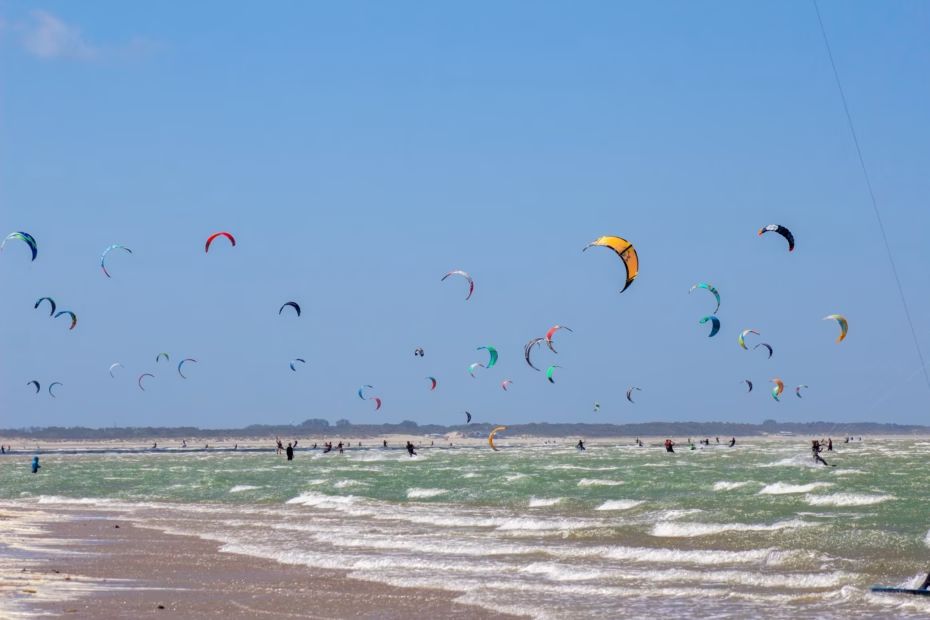
Los Barriles is well-known for sport fishing and wind sports. Most of the tourists come for one or the other. Along with La Ventana an hour up the East Cape, Los Barriles is considered the top kitesurfing spot in all of Mexico. I’ve met people who came here 20 years ago on a fishing trip, or to wind surf, and came back over and over until finally they bought a house. Others make the pilgrimage every winter, some renting and some dirtbagging out of a van in the arroyo. In summer they make their way to Hood River, Oregon or Cape Hatteras, North Carolina to chase the endless summer. Most winter afternoons in The Barrels, a steady wind fires up around noon and blows south parallel and onshore to the beach until about 4. A car can drive down the beach for a pickup, and if all goes wrong, be comforted that after a few miles the land turns westward, forming a perfect catcher’s mitt for the lost kiter.
I spent my first winter in Baja learning to kitesurf. As an expert mountain biker and advanced snowboarder with decades dedicated to each, I was both genuinely humble and supremely confident that if others could learn then surely so could I. More important than strength, fitness or body control, I have a highly curated capacity for suffering. My sarcasm and stoicism screen the entrance to a deep black psychological Pain Cave hardened like a Normandy bunker through years of 1000-vertical-feet hike-a-bikes, cactus collisions, icy yardsales smacking joints in the sleet and breaking a thumb, and tree-hole burials that shoot my pulse over 200 to claw my way out. I came bearing a patient approach and realistic timeline for at least 10 days of struggle with little payoff and only incremental improvements. I had three months to learn during my first season in Baja, and years of subsequent time to grow. I took the long view. If a day was rough, I’d cheerfully step back until my attitude was recharged with beer and snorkeling, and my rope burns healed. I’d gird myself back up by my loins and re-rig my lines with a smile.
Mike Tyson famously said everyone has a plan until they get punched in the mouth. I love that line. Everyone loves that line, its infinitely quotable along with Lance Armstrong’s “Pain is temporary, quitting lasts forever”. I also love “Call me Ishmael”, because hunting Moby Dick was easier and safer. Kitesurfing is the hardest thing I’ve ever tried. Drug impotently through the waves gagging and choking on brine, splattered on rocks, snared in my own lines, my head ringing from slamming into the surface, my stomach heaving from ingurgitating seawater – each day I invented a new form of failure while spending thousands of dollars for the privilege. I should have gone fishing.
For our wedding, Amy bought me a week of lessons at Exotikite, a long-standing shop in Los Barriles. Its owners Ian and Megan quickly became friends the first time we met. Ian has been kiting since he was a boy, and his shop is an institution of safe instructions and community. Megan is an entrepreneurial wunderkind with a great sense of place. Exotikite feels secure, it feels reliable, it feels mishbacha and caring and cognizant to my struggles.
A friend described lessons at another shop, where his instructors got high before each lesson. My friend was wrenched so hard by his ill-fitted harness he cracked a rib. That is unconscionable negligence. Get baked on your own time, not during $100-an-hour lessons. It’s Baja — you can’t find a less irresponsible opportunity for a safety break? Ian’s team, by contrast, has nearly killed me a dozen times, but, they do a flawless rescue and always share exactly how they tried to warn me I was about to smash down before it happened, thusly demonstrating their didactic and diagnostic excellence. Note: this review sounds better in person after getting lugged out of the ocean than it does on Yelp.
Instead of a stoner for an instructor, I got Graham. Graham is a curt, disciplined, ferociously direct Brit who tells it to you straight and suffers no nonsense. Graham rat-tat-tats instructions, corrections, and corrections to the corrections. Sometimes I asked Graham to just be quiet and let me process, so much specifically valuable and critical instruction marched out of his mouth so fast it addled my brain. Early on in my lessons we used radios to communicate while I was on the water, but quickly I preferred the silence as his instruction was overwhelming in its perspicacity. When you think you are about to die, someone telling you it’s about to happen, how to avoid it, and what you should do next time is too much. Simplicity like “eject” or “grab a breath you’re going under” is much more helpful in the moment. Eventually I treasured my failures and Graham’s post-mortems, so I could gain one or two nuggets of his wisdom and build incrementally on them. Graham could Ted Talk a room full of influencers into submission about kiting, while totally improvising his presentation. Then he’d pop outside and promptly fix a stalled car or rescue a puppy stuck in a drainpipe.
If you are the type of person to freak out seeing a truck full of Mexican federales drive past with machine guns, you wouldn’t like Graham. Graham is not a wet-nurse, and only after 6 months did I receive a chaste, perfunctory hug from him. But, If you were a 15 year soccer dad used to the penetrating critiques of English coaches, and a humble coachable student like me, you would drop to your knees and tear your clothes and beg Graham to have you as his mentee. And have your back. Every move I made, every screw-up or success, Graham saw far ahead of them happening. I would crawl back to the beach and he would describe exactly what I did from 300 yards out on the water, good or bad, always seeing my body language and whatever doom was impending. Graham personified “stiff upper lip“, but he was also incredibly empathetic and kind, as far as possible for a laconic Englishman. He is one of the nicest people I’ve met in Los Barriles, and probably the best instructor in any sport I’ve ever had.
Graham is pale, paler than an Irish ginger, the palest of ghosts in all the British Isles. I often wondered how he was not a walking freckle, and if he dunked himself in SPF 50 every morning or slept in a wrap of Banana Boat each night. His dearth of basal cell carcinoma reinforced his competence. To be that pale and that unsunburned after living years in Mexico takes skill, foresight and discipline. We’d go to the beach and Graham would have an extra pump hose, an extra control bar, a tiny 5/32s hex wrench for attaching a new chicken finger to a safety loop. Asking if he had chapstick was too trite to bother. Of course he did, and ibuprofen, a buffet of sunscreen choices, dramamine, gauze, tweezers, and a portable defibrillator. Graham is one tough hombre. He shared skin-crawling stories about kiting wrecks, motorcycling wrecks, of cleaning out his own wounds with a green scouring pad in the shower because the ER wasn’t prepared enough. He’s stronger than a Chuck Norris meme. “Graham doesn’t kitesurf, the wind gets out of his way. When Graham hits the water, the water recedes. Graham once kited upwind, both ways, then did it again. ” Kiting throws amplified wind, water and terrain at you. Kiting’s exponentiality of force can, literally, kill you onshore the moment you strap in. I can’t ever express enough gratitude to Graham for helping me through my precipitous learning curve and protecting me.
Day 1: I crashed my kite onshore moments after launch. Welcome to kitesurfing, loser, time to die. An inauspicious and foreboding beginning. I was aghast. Graham’s gaze revealed nothing.
A kite is a 9 meter wide ice-cream scoop for the power of the wind. It has four lines, of 24 meters each, attached to a control bar attached to a harness worn around your waist. The kite rig has half a dozen adjustments, to empower or depower it, like gears on a bike but all supercharged. The kite can pull, steer, dive, speed up or calm down. It can launch a person 100 feet into the air, or 100 feet drug along the sand if you screw up getting on or off the beach. Crashing on the beach takes a day or two until your discover all the bruises and abrasions, a slow-developing road rash. In Rocky Point, 10 years ago before all the 4x4s turned the entire dune in front of the Morua Estuary’s into powder, there were two crusty, pebbly lines that ran from the top of the Las Conchas spit to the edge of the water. It must have taken years of wind for the sand to fall and the crag to rise. 200 vertical feet, and both lines had just enough rime on them to roll my fat-bike no-brakes down through 20 seconds of fear, balance, and glory. I called the rocky line “Speckles” and the jumpy line “Spots.” I’d do a few runs down them each time I peddled the Las Conchas shore at low tide. The rush put an extra glow on every ride down the beach. One day the crust on Spots was really really REALLY firm, a humid evening toasted down by sunrise and low tide. The bike grabbed so much speed it launched 12 feet off a lip that had formed on the hillock. I stuck the initial bounce of the landing, but splayed the second bounce, faceplanted, and slid 10 more feet down the dune. I lost only my hat, and nothing else, and felt so empowered to have no other damage after such a violent wreck. My quad started throbbing that afternoon, and turned beet red over two more days. My whole left side – quad and hip and elbow and knee – stung every dip in the saltwater the rest of the weekend. Sand is not as soft as it seems. Crashing a kite on the beach is so much worse. Instead of just 10 feet the crash goes on and on and on until you desperately unhook your safety and detach. The kite eventually plonks into whatever catches the lines. Graham taught me to hold on to the safety until I got in the water, to be ready to rip it as soon as things went wrong, but even Graham can’t teach clenching the fuck on to your safety when you are clanging bodily down the shoreline.
With enough practice, you can control the kite with two fingers while not even looking. You can jump 30 feet and have the kite ease you down like an angel.
Day 2: Strapped to Graham, we got in the water harnessed together to bodydrag. Bodydragging is where you fly the kite without a board, while you lie in the water. It’s an essential skill when you launch out past the shallows floating your board beside you, or lose your board and have to drift to retrieve it, or unmount to gently approach the landing onshore. Prior to getting on a board, a new student learns about kite control by bodydragging, while diving the kite for bursts of power and steering left or right, learning to keep the kite in the air and to feel the powerdives against your harness. Its fun and relatively safe, unless you are harnessed in tandem to another person, trying not to swallow water or crash a kite while you both keep your lower bodies as inert as possible.
Bodydragging became secondary to not getting kicked in the balls or kicking Graham in the balls. After dozens of failed kite sessions, I can say confidently that – if you are wearing a life-vest and a helmet – there is very little a kite can do that is worse than getting kicked in the balls. Not slicing a digit, not losing a board, not wrenching your back. I doubt the character of any man who has never gotten kicked in the balls, or who has never gotten punched in the face. Men are raised to charge stupidly into folly, carried by ego and testosterone and the evolutionary need to self-promote. Getting kicked in the balls is an indelible moment in character development, where a male learns that some things are simply not worth the price. I am 56, I have learned through failure and savvy to mitigate risk, follow the teachings of Sun Tzu to know my enemy and my terrain. I haven’t died in battle, gotten beaten unconscious in a bar fight, or gone to the hospital riding the Red Bull Rampage. I am, in sum, a sensible man. All of which evaporated the day I chose to kitesurf. Graham and my multiple near-ball misses were metaphors for my kiting, and low level-setting for a successful day. I just barely did not get kicked, I just barely did not kick my instructor. I Iearned how to use the left and right pulls on the control bar to dive the kite, and a whiff on understanding the wind window enough to mostly go in my intended direction. On Day 2 snowboarding I had learned how to toe-turn, and began 10 days of exponential progression that vaulted me from novice to advanced in a single season. On a snowboard, if you’re not falling, you’re not trying. Falling in fresh winter powder doesn’t hurt. If kiting forever stopped on this second day I would have believed myself on the fast road to success and died happy convinced I was on the verge of becoming an advanced kiteboarder. Alas, kiting only gets harder.
Day 3: Dragging along in the chop trying to get my feet into the board, 15 long gagging minutes of my futile first attempt at mounting out of the water. You lie on your back and pray to control the kite from this position. In brief moments of the kite sitting calmly at 12 o’clock in the air, for a mere second you turn away your concentration to hurriedly drag the board over your shoulder out of the water and put it in front of you so you can slide your feet into the straps. 3 out of 4 times the kite breaks loose, you give up on the board, and try not to crash the kite. 2 out of 3 remaining times I can’t manage to pull the board forward and I have to use the kite to drift back to it and start the process all over. Half of the remaining attempts the board shifts positions out in front of me before i can stuff my feet into the footpads. I gave up everything to not have the kite crash. I twisted, turned back over, fought the kite, tried to align the board, and lost the alignment again and again. Every motion is foreign, frightening, flailing. 1 time out of 20 I had a legit try at mounting the board.
A random kite crashed down on top of me. This was the equivalent of getting blindsided by a moose at a National Park, which happened to me while grinding halfway up the 3000 vertical foot Armstrong climb in Park City. One moment, progressing streadily through a big beautiful steady 8 mile climb climb. The next moment, shock and chaos and fear of getting trampled by a 1400 pound Bambi.
The other kiteboarder’s lost control bar spiraled through the water, and snared my lines rendering them totally useless. I pulled the safety on my bar to depower the kite and drop it in the water. The tangle around me was overwhelming. A kiter has a second safety leash, that connects the harness to the bar. Pulling it sets the kite and rider completely free, and its only pulled when you are royally and truly doomed. I pulled that too, the only time in all of my training that I completely cut loose. The kite was free. The 8-line knot on our two lost bars must have taken the Exotikite staff hours to unwind. Graham, as was his way, rang the Bat-phone, and within minutes Ian floated down from above like Superman, alighted effortlessly next to me, offered his hand and implored “grab hold, citizen!” The entire Justice League had mobilized to rescue me and be so smooth doing it. Ian towed me to the safety of the beach, then vanished back into the clouds to find my kite somewhere on its way south to La Ribera. My ribs were not broken, I was onshore with nary a chapped lip before my $200 lesson had even ended.
Day 4: We rode an ATV up to North beach, close to our house, to get a nice long downwind run. North Beach sits at the entrance to Los Barriles’ second arroyo. It crosses over a jumble of rocks, vomited out from the hills during the winter rains and summer hurricanes. River rock and rip-rap give way to 12 and 24 inch boulders. Entering the ocean with a kite involves stumbling through the surf while daintily picking through the rocks while the kite rips the novice user in all directions, unable to concentrate on the kite while fighting the surf and rock. I crashed my kite launching, I crashed my kite entering the water, I crashed my kite once I finally got a few feet deep, spitting out seawater all while Graham rat-tat-tatted too much information at me. Over and over the kite went down, until it was wrapped around a buoy like a tetherball 100 yards out. After the donkey-punching of the day before, I was oddly proud of this new never-performed disaster. I got my kite untangled, diving down along the buoy to unwind lines. Graham was pissed at me for risking my safety. That put my stupidity in perspective, that Exotikite would rather lose the kite than have me drown. Thanks Graham and Ian.
Day 5: The kite and I become a ball of cat yarn. It took 10 minutes to create a conundrum that took an hour to drift pathetically into shore. I’m still amazed at not tourniqueting a body part. The lines became completely twisted around my legs and my toes. I’ve been instructed to keep your legs very still after you pull the safety release, but in the middle of an ejection it hard to focus amidst the violence and twisting and struggle to breathe. Slowly, daintily, I flicked my toes then my calves then spun away from the lines round my hips. Fighting the instinct to tread water with my legs, only my head was held above the surface thanks to my life vest. Foot by 72 feet I wrapped my lines back around the control bar. When hopelessly floating in the water with no chance of remounting, I was trained to try to tug the lines so the downed kite angles just a bit into the onshore wind and eventually gets to the beach. It’s ugly and the kite looks like a dying bird that broke its neck hitting a large patio window, but it actually works 10 or 20 degrees of tugging the barge into the wind. The wind and the kite and lines don’t always cooperate, sometimes flipping an edge to catch wind away from the shore, sometimes unravelling, or slicing dangerously through your fingers. When I finally ran aground, Graham gathered up my neatly wrapped lines, inspected me for wounds, and pronounced I’d done a top job of self-rescue, mate. I was happy, I guess.
Day 6: Day 5 all over again. Towards the south end of the beach, dozens of sport fishing boats sit at anchor outside the Las Palmas hotel. Its quite beautiful from the shoreline or the mountain bike trail on the ridgeline above, and a very fun cruise on the paddleboard to see all the boats and gear up close. Down in the water with a stuck kite I felt like an oil tanker waiting for a mine or a drone strike in the Strait of Hormuz. Do I try to drift past the rows of boats for another 30 minutes, or hope for just enough stability and predictability to slink through the gaps in the flotilla? I did some of both, for what seemed like hours. I did not wallop their hulls or catch their anchor lines. I also did not get up on my board or anywhere close to it. I spent 2 hrs and $200 to enjoy a very expensive afternoon tubing, and a free ride on the hood of an ATV back to Exotikite.
Day 7: I almost stood up on the board! For 2 seconds I was vertical. This is what a baby feels like at 12 months with their very first toddle, but having only the promise of self-actualization, instead of my chagrin of underachievement. I was exhausted, my core completely fried from 90 minutes laying in the water after finally muscling the board onto my feet while grasping grasping at the wind to lift me. On a snowboard you frequently fling yourself up from your back with a powerful core flex. I always imagine myself in a movie about ninjas, who can snap from supine to attack stance with a pop of their bellies. It’s an inspiring thought but fails to acknowledge the help the snowboarder gets from gravity when pointing down-slope. Kiting proved itself again to be beyond compare in difficulty. I pulled the plug on the day and dragged to shore, for once without a kiteastrophe. I had launched the kite, I had entered the surf, I had tried to put my board on my feet 50 times, and I had drifted downwind almost a mile safely. Success! Er, nope, tore my bathing suit and gauged my toe on a rock, and couldn’t wear shoes for 2 days.
Day 8: Keelhauled through the shorebreak with my waist harness wrenched up so violently it bruised both my ribs and coccyx. I used a bidet for the next week. Everything else about this day is a dark purple blur of failure, dishonor and mortification.
Day 9: There are different sized kites. 9 meters is about average. If the wind is heavy you might fly a 7 meter kite, which scoops less power to counterbalance the stronger wind. If the wind is light, you might fly a 12 meter. The difference in handling is pronounced. The bigger kite is slower to respond, but more stable. The small kite is nimble and twitchy. Like my bikes and my cars, I prefer responsiveness over bulk. But, if the wind is only in the low-to-mid teens, the big kite is your bestest option for flying that day.
Unless you are me, in which case the big kite is 9 to 15 feet more resistance to relaunch after a crash in the water. When the bigger kite downed, I found myself helpless to pull an edge enough for the mild wind to scoop it back into the air. It was irreversibly stuck, and with the span so great I was unable to even control my drift into shore. I waved at the sport fishing fleet as I drifted by. Hola amigos, tienen alguno dorado? South of the sport boats, the beach briefly angles further inland and immediately the distance to shore doubles. I became even more rueful, thinking I was going to float all the way south to where the beach bends eastward. Julian, another instructor who I’d gotten to know earlier in the season, came sliding by on his foil, sitting, relaxing, as if chillaxing in an adirondack chair on his porch. Julian offered me a hand and an effortless pull, I don’t think he even shifted in his seat. The only thing that could have made me feel smaller would have been Julian holding a TV tray, eating a sanwhich and drinking a double-sugar Mexican Coke during the rescue. I’m sure he was capable of it.
Day 10: My first session on my own without Graham and Exotikite. I can do this!!!
I was using my own newly-purchased used gear for the first time. I can do this!!!
Everyone said now was the opportunity to give up the board leash, it will only hold you back. I can do this!!!
I lost my board in 14 seconds. It took me 20 minutes to bodydrag to shore, 10 minutes to swim out and find the board, and I discovered my new-used kite came with a free hole. $75 later, a local kite mechanic informed me it wasn’t worth fixing as the other valve seals were similarly dried and cracking. Another $200 day of futility.
Day 11: I setup and launched in front of Exotikite, so the team could give me a once-over before setting out alone. I can do this!!!
2 minutes on the water, and my session was irretrievably fucked. I can’t remember how, no one was there to save me or analyze. The sense of isolation wrecked me for the day. My kite becomes my Queequeg’s Coffin, 45 minutes adrift before washing up on the beach. I copied my tattoo onto the kite canopy, just like Queequeg. We will both die.
Day 12: I have gotten just a little better at holding the kite still at 12’o’clock. I am less-terrible at pulling my board from behind me and sliding my feet into the straps. I almost stood up. I stood up on the board for 3 whole seconds, I am a superhero! Then the kite immediately looped three times around itself and kamikazeed into the water. I have no idea what happened, what went wrong, why. The Cosmos is out to destroy me. I spent 30 minutes drifting to shore and an hour unfouling my lines. I am not progressing at all, I am hurtling backwards and downwards, Icarus with melted wings. I am worthless, I want to quit, I want to die.
Day 13: My first glorious ride lasted 10 entire seconds. It happened so miraculously – how do you whiteboard a vision from God? For the briefest moment I found balance on my feet, between the force of the kite and the drag of the water. I harnessed the wind, held my kite purposefully in the wind window and glided like Katarina Witt across the water. It took 90 minutes of flailing and faceplanting for 10 seconds that would leave me glowing for months. I retired for the season. Good night folks, please tip your servers and drive safe!
Stats for the winter season: 22 hours, 13 sessions, $2600, 1 successful ride that left me totally hooked. See you soon Los Barriles.
We returned to Casa Yippee Calle in mid-May, for a two month stay. In June, occasional north winds gather around the peak before Rincon beach. I don’t pretend to yet understand the patterns, La Ninas or marine layers. Only that I had arrived 3 weeks earlier to brutally-hot mountain biking and gusty paddling, played pickleball every day, when suddenly my friends proclaimed that its a MOTHERFUCKING WIND DAY and I best grab my gear for a rare session during the shoulder season.
Day 14: I drove an hour southward to Rincon, a new adventure to a new part of the East Cape. Rincon is 10 miles south of La Ribera which is 10 miles south of Los Barriles, and roughly where the development ends. 10 miles down a crappy road, then a mile down a double-track littered with free-range cattle poo put us at an empty beach. If you were to picture “Baja”, Rincon was it.
I was so stoked to get out there and shred!! I’d had 6 months of memories, visions, fantasies for kiting. Freshman year in college I went 6 months without a kiss, or a hug, or any dates at all. I felt 19 again and ready to blow.
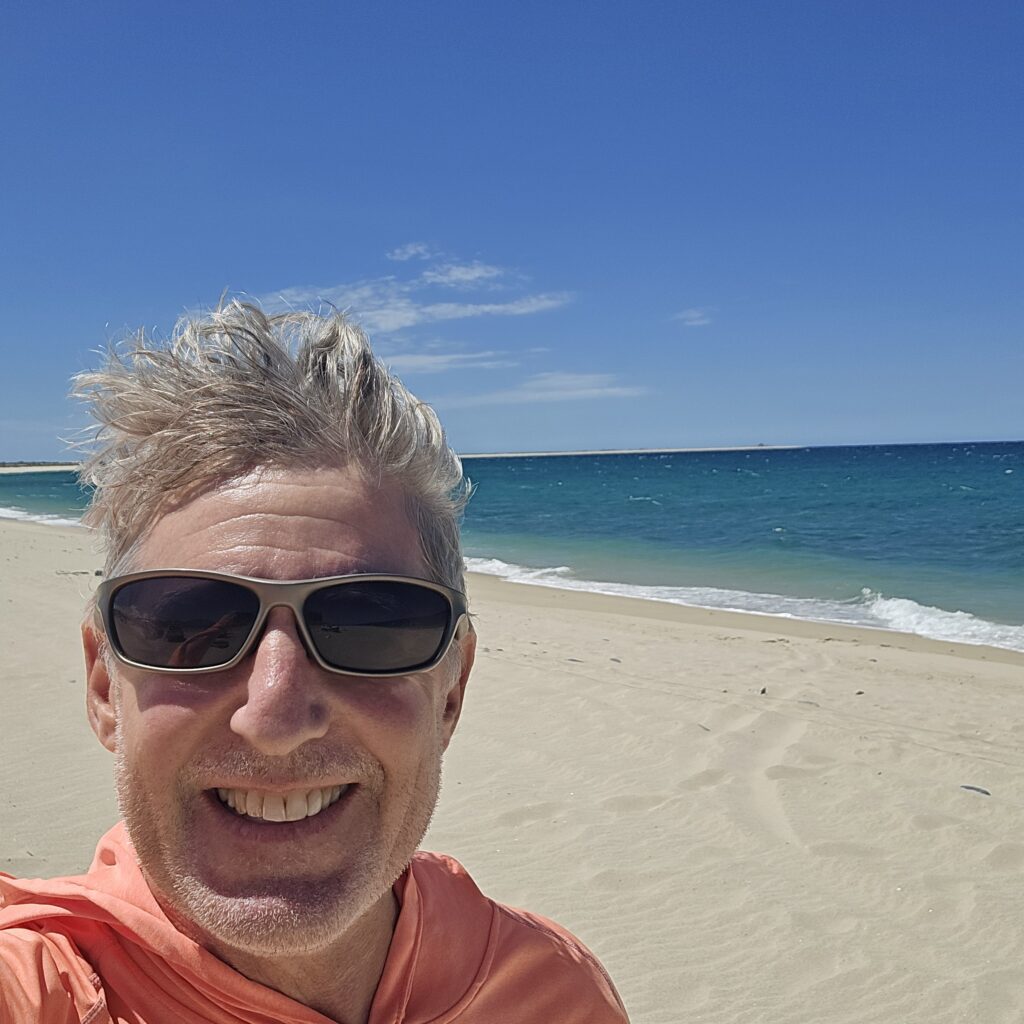
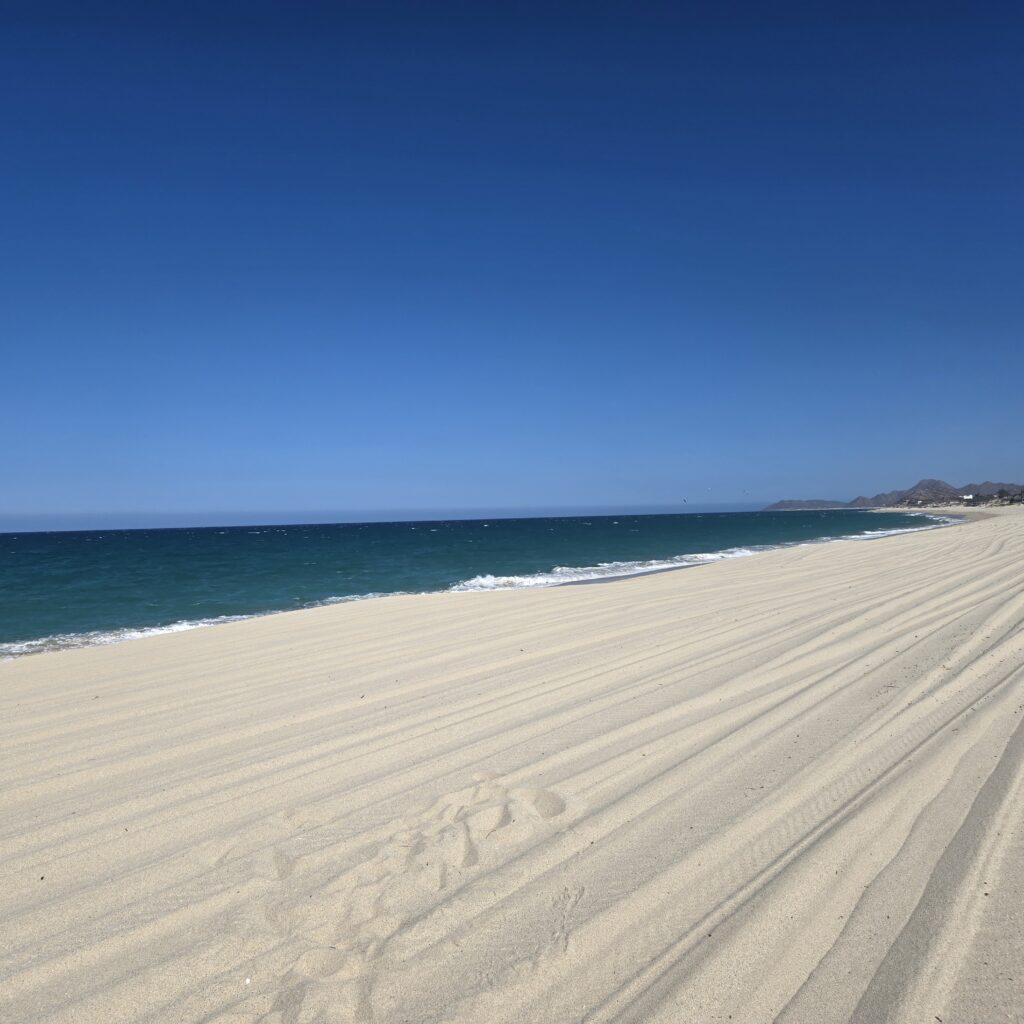
When we got on the beach, the whipping wind and needling sand dislodged me. I began to unpack the kite but lost my direction like a scrap of instruction ripped out of your hand by the gale. All the things I had forgotten over the Spring inundated me with a panic attack. “Scared to death and scared to look, they shook, cause aint no such thing as halfway crooks.” My embarrassment doubled-up on my fear. I stood shocked still on the beach, petrified. The only other time I have felt that way before was 10 years prior. My Australian Cattledog Dia, still a pup, ran directly in front of my bike in a moment of youthfulness and bad decisions. She crashed us both, and ended with her tail wrapped around the axel of my front wheel, sliced, and broken through by my brake rotor. We stared at each other both bewildered and speechless and bloody. She tore at my hands when I tried to remove the wheel and free her. I almost did the same to my friends on the beach. I was lost and in shock.
I have long had a theory that sports are based on a tripod of physical ability, technical skill, and confidence. If any one fails, the other two can pull you through. I have clung to this belief through so many ugly circumstances, only remembering how I leaned on what worked and was able to overcome by focusing on two of the three. For months learning to kite I have clutched to fragments of physical ability, while floating my kite to shore in a self-rescue, lacking any skill but a belief that someday I will have improve. Like Ted Lasso, I believed in believe. I fell back on routine to overcome my panic, and ran my 24 meter lines out on the beach a few times, refamiliarizing myself with the first and most basic task of kiting, to someway somehow claw myself up out of this hole of insecurity. I had to accomplish something, anything, any single thing to hold onto as progress for the day. My friend Kim thankfully (ok, not really thankfully) lost her foil in the water, somewhat reassuring proof that even experienced athletes have setbacks. I leapt at the opportunity to drive the 4Runner a half mile down the beach and help her search for it in the tide, and put a deposit in the karma bank. It gave me a sliver of confidence that if, IF, I could get out on the water some chauffeur could drive my car downwind to retrieve me. It was a very very little, but it was enough for that day. It was all I could handle or hope for. I needed to run home and hide in a dark room and cry.
Day 15: Rincon again. 90 minutes on the beach flailing and imploring my friends to help me setup, losing any pretense of competence or self-respect. Begging. A pauper. Everyone says kiting is a long climb, and we’ve all been there. Its a comforting refrain, and also a vacant platitude that does nothing to alleviate the overwhelming sense of shame. I can’t even get my gear setup to dip a toe in the water – I’m an embarrassment. Why am I doing this? Why are you all even talking to me, I am trash. Day 15 on my snowboard I was riding double-blacks, and riding them well. The falls on the snowboard didn’t hurt, the powder was soft. Gravity kept me pointed downhill all afternoon, with only 2 footpads to worry. I hate kiting. I hate it and hate myself, this is a hair shirt and this is my opprobrium. I should have gone fishing. I should be reading Moby Dick. I should give this stupid shit up. I was cowering under the feeling I would die the next time I stumbled out into the surf.
Bless you friends, I could not have survived the day without your compassion and hand-ups of residual knowledge. I was able to lay out my lines, inflate my kite, string it all together, strap on my harness and safeties, launch on the beach without piledriving into the sand, and body drag 15 minutes downwind. I got wet, and I survived. Kim helped me land my kite and bundle up for the walk back upwind. I shook the entire time.
Day 16: I hired Graham to drive to Rincon with me. POSSE IN EFFECT! Sir Mix-A-Lot got nothing on me. Posse on Rincon, yo! Graham reviewed self-rescue protocol with me, reviewed launching on the beach, reviewed how to mount my board and step into the wind window. Oh well whatever nevermind, I invented new ways to fail. With expanded ability to launch the kite and grab the wind, I have developed expanded abilities to lose control with exponentially more power. I human-cannonballed through the air. If it wasn’t so terrifying it would have felt like a coveted attraction at a waterpark. Me, flying horizontally 15 feel and splashing into Baja’s azure waters. The metal ring connecting my board leash to my board exploded under the ferocity of me being ripped into the sky while the board anchored in the water. The kite crashed, blessedly not twisted like the carcass of a dead pelican. I was able to get it back in the air with just a few tugs of the lines to lean it into the wind, but my board was long gone. I bodydragged into shore, while my board floated north towards La Ribera. I could just see it over the whitecaps, 500 yards away. Graham effortlessly settled my kite on the beach, strapped into his harness, and flew the kite out to sea. He returned upwind riding my board before I even had the car turned around in the deep sand. Graham 1, Toyota 4Runner 0.
Kite leashes are straps that connect to your harness. A leash bolts into the screw-holes that hold one of your four fins onto the board. They are a subject of great debate. On the one hand, fixing yourself to an anchor with a blade that can fly out of the water is a terrible idea. As is handicapping your growth curve. Rip off the band-aid and improve!! But as a new kiter, getting even a meter away from your board in the water can be the end of a session. Struggling to control the kite, while your board drifts either faster or slower than you downwind, is evocative like Tom Hanks coming up just an arms reach short of Wilson in “Castaway“. I’m sorry Kiteboard! I’m sorry!!! See Day 10.
Kite leashes keep the board close, and I chose this over any other risks or handicaps. A good leash, like the one which I paid $90 for, connect via a retractable tension line that can string out 10 feet as needed, and then gradually pull the board back to you when slackened in the calm before another attempt to stand. It allows the beginning kiter to mount, fail, mount, stand up for a brief moment, crash, mount, fail, mount, stand, fail and mount again. It greatly improves your efficacy in the water when mounting the board is the first and constant refrain in your kiting session. I pulled my board through the water from back beyond my left shoulder onto my feet at least 30 times on these afternoons. It caused a recurrence of tennis elbow in my left arm, similar to when I spent an election season hanging candidate signs by pounding rebar into the indurated Arizona earth with a postholer. A downside is that the leash creates incredibly drag on the board when the board is not on your feet. With the kite powered and the board stuck in the water, anything can happen and it’s all bad. In my case, the leash hardware blew apart under the strain.
Kiters all strive to shed the leash as soon as possible, but I needed the leash at least for a few more days. Graham had tools and rope, because he’s Graham. We rigged a thick nylon line through the remaining loop of the webbing that was still attached to my board, drove a mile up the beach, and I launched again. A few 2 second runs – up, try to balance, fall. A few runs of 10 meters and 3 seconds, a few more impressions of deranged human flight – think William Katt hurtling towards buildings in “The Greatest American Hero“. Still, this was progress. In each doomed departure I managed a moment, maybe two, of feeling the board under my feet edging into the water, and the effect my body-weight could have leaning back against the kite into the harness. Bit by bit, poco a poco, I learned to get my feet into the board and felt the chaos slowing down.
Tnen the webbing ripped out from the washers holding the leash to my board. Another drift to shore, a helpful stranger returned my board to the beach. I slunk back into my Pain Cave for the drive home and remained cowering in that darkness all night. It seems I can not catch just one break to just one good day.
Day 17: Graham and I drove to the far south end of the beach to be free of any distractions. My launch was perfect, and yet, the moment i got in the surf I tumbled over and my kite knotted itself in the water. It wasn’t the kite, it wasn’t the rocks, it was just another day being me. I was furious. By day 17, I should be able to diagnose what in the fuck just happened and avoid it. But, I couldn’t. My stigma swelled as I drifted 10 minutes into shore. Graham and I sorted all that “allegedly” needed sorting on my downed kite, which I think was his ruse to keep my confidence up. Graham did not want to pile insult on injury by deflating and driving back up beach, so, we launched about 50 yards upwind from the collection of other kiters and cars. To a competent person this would be an absurdly safe distance. To me, this was a unique opportunity for injuring innocent bystanders along with me.
The kite bar is fixed with a hard plastic ring and rod, colloquially called a chicken loop and chicken stick. The chicken loop goes inside a hook on your harness, and the rod on the chicken loop is laced between the chicken loop and the harness hook, thereby locking the bar to your harness. The chicken stick blasted apart before I got five steps down the beach. I heard it SNAP, then found myself tumbling through the parking lot.
This is the most dangerous disaster for any kiter – out of control dragging across the beach, the cars, the surface rocks. Kiters and kite instructors tell you terror tales like old grandads who survived Iwo Jima. “DO NOT EVER LET YOUR HAND OFF THE SAFETY WHILE ON THE BEACH!” I didn’t, I didn’t let my hand off the safety, the safety shattered beneath my hand. I continue to create unbeknownst methods of failure. I debrided my quads and calves. I yanked my back and yanked the safety on my harness. The kite swooped into a woman lying on the beach, like an osprey blitzing a fish. Dazed and with sand in my eyes, I thought the kite was swallowing her car.
When I was 18, my friends and I loaded into a couple cars in the middle of a snowstorm, drove to Camden, New Jersey – the poor city between us and Philadelphia – and managed to buy 3 cases of beer from International Liquor, dodgy store in a very bad neighborhood. The clerk behind the plexiglass-covered counter took our money without looking up. We turned down corner-boys offering crack, and arrived at a house party triumphant. We were heroes! We played quarters and chugged beers while our friends marveled at all our prowess of being Seniors in High School. And then, I hurled. I sprayed 10 rounds of drinking games all across the host’s upstairs landing. I was so dizzy that I don’t even know if this recollection is legitimate, or fabricated to hide even worse humiliations. I remember my friend Adam hustling me out of the house and into the car, and me driving home 15mph in a snowstorm while he coached me every time to massage the brake. Somehow I got home and my Mom screamed at me for driving so drunk. I hid, the hangover lasted 2 days, I slunk back to school, I denied ever having been at that party.
Graham and I loaded the car with my kite while the women on the beach wailed, and pointed, and accused. I refused to make eye contact. We drove away fast. Worse than a puppy with its face rubbed in its own piddle, I shrunk into my debasement. I wanted to quit. I wanted to quit, right then, so badly after so much failure. I wanted to sell our Baja house and pretend kiting was all a bad night’s sleep. Graham told me later he took my meltdown as a personal offense, which is kinda the most caring thing an instructor could say to you.
10 minutes, gatorade, and a quiet beach later… I launched again. I stumbled in the surf and my kite hit the water, cornering my psyche to renewed failure. I did not quit. Somehow, someway, I slowed down the clock and got the kite in the air. I did not quit. I did not quit. I had the best session of my life.
When you pull on the left or right side of the control bar, the kite dives to that side. It assaults you with a ferocious but short-lived burst of power, wrenching you to the dive side. Using this vector is how you get up on the board and initiate momentum through the water, aligning the board edges into the kite’s pull to minimize resistance. The fins of the board hook up for lateral stability, and magically your are balanced and sailing! The kite dive to the side has to be aggressive, but not so aggressive that you lose control and are pulled into the air. And not so deep that the kite touches the water, or the climb takes so long to re-gain altitude that your power stalls just as you gain enough momentum to sail through the water. This is the nuance I’ve been shadowboxing my last 10 days.
Suddenly I had it. I wish I could bottle the Why to use against every upcoming failure. One might construe the glow of the day ending on that high as the bottling. 10 second runs followed one after the other. I overdove and was pulled bodily into the air, but not without regulation. Graham warned me of two things – to let my feet out of the board so I didn’t drag it with me, and to relax my hands on the control bar so it slid away from my body and the kite released its energy. Loosen my feet, loosen my arms, slide out of danger. I made that slogan up, and perhaps will submit it as an article to Kitesurfing magazine. Graham says everyone wants to pull in when things go wrong, to hang on the kite for control. But pulling the center lines in accelerates the kite’s power by pointing it directly into the wind. Sheeting the bar out relaxes the kite, slows the crash and allows a recovery. Until now I thought all the power came from the dive. I was wrong. I was glimpsing through failure the role of the two center lines, and the full 9 meters of sail.
Failures were not failures in slow motion and nearly under control. They were lessons. Over and over for a mile downwind I somehow got up above the water again and again and again. I had learned to get the board on my feet, and now was learning to parry the first violent pull from the kite, and turn it into something sweeter. When I overpowered the dive, and hurtled into the air, I could feel the kite release power and come back to neutral in the air even before I crashed back into the surf. A comparison to snowboarding would be your first drops from a cornice. Those 3 or 4 feet free-falling from the overhanging curl of snow seem impossible, an open invitation to cartwheeling down the mountain. After a series of falls and stammers you figure out how to brace the initial impact, balance and flow just enough to not fight against the inevitability of gravity, and grab a carve the first possible moment, stepping incrementally towards control as you hurtle down the mountain face. The powder cornice becomes just another small skill in the very large toolbelt, and an excellent source of photos and tall-tales.
The kite did not hit the water again that `day. I finally quit because my legs could not go another round.
Day 18: Glory is fleeting.
Graham and I drove back to Rincon, we chatted about “Rock the Bells” radio and sang rap tunes together, we setup the kite in a beautiful steady wind. I launched smoothly, drug out 100 yards with ease. I stood up on my first try. Then a line sprung out of its retaining loop on the kite. PLOINGGGG! The kite instantly went askew with only 3 of 4 lines attached. My friend Hugh, my Virgil to take up kiting, told me he had never had a line spring loose from the kite, ever. Ever. Hugh has crossed the Atlantic Ocean 3 times in a sailboat and foiled from Rincon to Los Barriles and back through shark-infested waters. I have a gift. A pathetic, wretched, toxic talent for failures.
SNAP-BANG-ZZZZ. It didn’t crash like normal, overcharging into the water or looping around itself in a death-spiral. It flailed like a wounded bird, sideways, trying to get up and misbehaving against my self-rescue protocol that only half-worked because there was uneven tension on the kite. As you wrap your lines up during a self rescue, you pay close attention to having all four. Otherwise a line is snaking around you in the water, leading to all different dangers. I knew a line was unaccounted for, but couldn’t fathom what had actually gone wrong. Only that one rope was surely wrapping around my legs and toes and that I couldn’t even pull the kite into the onshore breeze. 30 minutes later I made it to shore, still trying to qualify how things went so wrong so inexplicably.
We spent nearly an hour untying knots, and swimming out to retrieve the board I ejected in the chaos. It pushed all my enthusiasms for my prior day into a corner. Competence at self-rescue is not a skill to be proud of. I knew Graham was bullshitting me when he said “cracking job of self-rescue, mate!” And told me that he had inspected the knots for me, as he always does, and to not blame myself.
We finally got the gear restored, and I went out for another long downwind run. The effort to go back out, I know, was a victory despite its lack of fanfare. I mounted, I stood, for 3-10 seconds, over and over, all the way down the beach. I thought I should be prouder repping the positives from the day before, but I wasn’t. This sport never, ever, relents. It never gives you a win. I am a loser on Day 18 inasmuch as I can fail again, and again, and again.
Day 19: Graham gave me one instruction. For Graham, terseness is significant. So significant that the one instruction was all I focused on for the entire 90 minute drive and prep and launch. “Mate, you are conservative on your powerdives, which is good and smart. But, instead of pulling up at 4:45 let the kite dive to 5:30. Let the kite take you, be aggressive. You’ve made real progress in your crashes, I fancy you will end up all right. ”
Dive hard. Die hard. Yippee Calle motherfucker!
I brimmed with optimism and intention. It was a gusty day about 25 mph. The kite too-quickly corralled the wind while I was strapping in, I lifted 4 feet off the sand, and I blasted down the beach following the careening kite. I never let go of the safety, and ejected after only one rebound off the deck. Is this progress?
We re-rigged and launched again before I had any time to wallow. Preventing even a moment of self-reflection is a testimony to Graham as a senior instructor. My smooth launch and drag out of the shallows felt great, textbook, but in the moments surrounding I started feeling a sharp stinging. I gave my calf and forearms a nice road rash during my crash. The buzzy discomfort charged me with adrenaline, anger, past the point of smart choices. It was Wednesday, we were driving home on Friday, and this was my last day until December. Today I will lean on confidence and physical ability, and employ the one technical skill Graham instructed that I was perfectly capable of executing. Today I will take risks. I dove the kite hard, and was rewarded with a pull out of the water and a run every time for 30 minutes.
I controlled my drift into shore, while we sipped gatorade and reviewed my successful session. Graham had one more singular piece of instruction. Dive hard and aggressive, but less deep. Snap the kite into a fast dive, don’t let it gobble up all its altitude. Go instantly to 5:30, and couple it with pulling in the bar part way.
Pulling in the bar seems to go against all the advice Graham had given me a few days earlier about how to avoid bad crashes. That was before I had learned to get the board on my feet, which was before I learned to not be overwhelmed by the pull from the dive, which was before I learned how to make the dive more precise and effective. Some sports you learn skills in parallel. Nothing in mountain biking about cornering affects your skill at looking ahead down the trail. Nothing in boxing about snapping your jab dictates using your hips for your cross. In kiting, every skill had to be learned in serial order. Finally, I was using the center lines as the kite’s real source of power. The center lines succinctly grab ten times more energy from the wind than the edges. If you stick your head out from behind a windbreak, you feel the wind push your face and influence your thinkig. If step out from behind shelter into the wind, your whole body gets blown back. This is the difference between pulling the bar to the sides versus pulling the center lines. Now that I saw the role of each line, and its place in the sequence, the power from the center of the kite became a manageable singularity, devastating but predictable once I stop fearing its dynamism and recognized its shape. The wind is a vector, the kite an accelerator with an arc of options. I saw this in my head, felt it, finally on Day 19. It took me a month deconstructing it and reliving it in my dreams to be able to write it down.
I dove the kite sharply and quickly to get out of the water and gain direction, while feathering the gas pedal by slightly pulling in the center lines
Originally published: January 30, 2026
Last updated: August 2, 2026